
Potomac Public Records Landscape
Public access in Potomac follows the office, not the postal place. The community is an unincorporated census-designated place, so there is no Potomac city hall holding a parallel set of files. Montgomery County keeps local deeds, court files, estates, tax accounts, permits, and detention records. Maryland agencies maintain assessments, vital certificates, statewide court summaries, business filings, and other public records. The table separates an online index from the source record because a search result may be only a pointer to a clerk file or certified copy.
| Record Set | Custodian | Online Index | Access |
|---|---|---|---|
| Deeds, trusts, liens, plats | Circuit Court Land Records | MDLandRec; records from July 1777 | Free account and images; clerk copies cost extra |
| District and Circuit cases | Maryland Judiciary and court clerks | Case Search; Montgomery civil from 1978, criminal from 1979 | Free summary; complete file at clerk |
| Assessment and parcel facts | Maryland SDAT | Real Property Data Search | Free, address/account/map search only |
| Birth, death, marriage, divorce | MDH, county health office, Circuit Court | No general public person index | Eligibility and record-specific rules apply |
| Estates and probate | Register of Wills | Statewide Estate Search | Docket search and downloads; office copy channel |
| County incarceration | Montgomery DOCR | No automated county roster | Call the 24-hour records line |
Open does not mean unrestricted in every form. Sealed and expunged cases, adoption and juvenile material, protected voter addresses, Social Security and driver-license identifiers, and recent vital certificates outside qualified classes are withheld or limited. A voter self-lookup also is not a browseable resident list. The general Potomac voter records rules belong to that distinct access system.
Accessing Potomac Deed Records
MDLandRec is the main online route for Montgomery County deeds, deeds of trust, leases, assignments, powers of attorney, liens, judgments, and financing statements. A valid email is needed for a free Maryland State Archives account. The county says the password normally arrives within about one business hour. At the courthouse, Public Information Room computers provide another path to Montgomery and other Maryland counties. Staff can help once a liber and folio, the deed book and page, are known.
| Search control | Type | When used | Potomac detail |
|---|---|---|---|
| Clerk | Dropdown | Required for book lookup | Select Montgomery County |
| Book | Text | Required for Jump to New Volume | Enter the liber number |
| Name | Search mode | One route | Grantor and grantee names are indexed |
| Liber / folio | Paired values | One route | Book and page reference |
| Tax account number | Text | One route | Use the Montgomery SDAT account |
| Indices | Browse | Optional | Opens index books and resources |
A recorded instrument can identify each person on the document, grantor or grantee role, instrument type, filing time, and liber/folio. The clerk scans the document, verifies the index, matches the image, and uploads it. Plain self-service copies cost $0.50 per page. Certification adds $5, while a triple seal adds $10, plus the per-page charge. Those seals attest to the copy; they do not change what the recorded instrument says.
Potomac Grantors Since 1777
Modern search screens are only one door into a long local record trail. The Maryland State Archives grantor index for Montgomery County covers 1777 through 1972. Historic equity indexes from 1777 through 1981 sit at the Archives as a separate series. That split matters when an older name does not appear where a current user expects it.
The Archives grantor-index image below shows the separate historic channel. Searchers working on Potomac land, an estate, or a family line should preserve spelling variants and the book/page reference before moving into deed images.
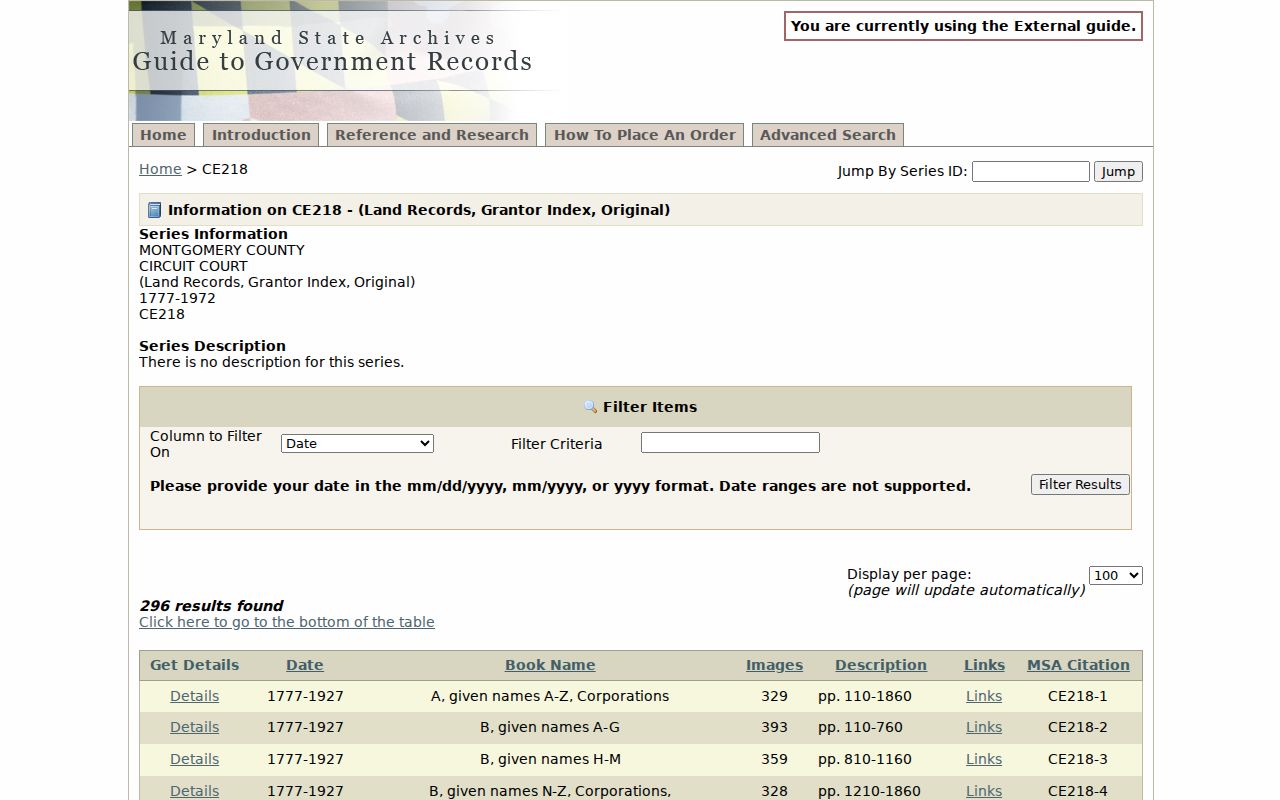
This index can bridge names to instruments across nearly two centuries, but it remains an index. The deed image or clerk copy supplies the underlying legal text.
Potomac Property Records Start by Address
The SDAT Real Property Data Search displays ownership from the last deed, mailing and premises addresses, values, sales, map references, and owner-occupancy codes. Yet it bars owner-name, town, neighborhood, subdivision, and ZIP searches. Choose Montgomery County, then use a street address, property account identifier, or map reference. For a failed address, remove directions and street suffixes, omit the house number, or append an asterisk to a shortened street name.
A parcel card can expose the account number, current owner line, mailing address, physical address, district, map, grid, parcel, lot, plat reference, transfer date, deed reference, and price. Only the first owner-name line may display, and abbreviations such as ET AL or T/E require care. The card is informational, not a legal title report.
Useful handoff. Copy the liber/folio from SDAT into MDLandRec, then inspect the deed that supports the assessment owner field.
MCAtlas adds parcel shape, zoning, and planning layers. County Finance separately holds tax bills and payment data, while permit evidence runs through DPS eServices. These linked systems answer different questions and should not be treated as one record.
Potomac Court Index Versus File
Maryland Judiciary Case Search offers statewide public summaries for District and Circuit Court matters. Names match exactly by default. For a partial surname, enter at least its first character followed by a percent sign. The wildcard cannot lead a term or sit in its middle. Broad queries return no more than the first 500 cases, so narrow by filing dates, court, county, or case type.
Results can include party name, case number, court, type, status, filing date, caption, city or state, hearing dates, charges, docket names, and disposition. A docket is the ordered list of events and filings in a case. The result is not the complete court record. Write down the case number, then inspect or request the clerk file for releasable pleadings and exhibits. Courthouse MDEC kiosks provide an offline public route when remote detail is thin.
Sealed, shielded, expunged, juvenile, adoption, and other protected matters will not appear. Some criminal outcomes removed from remote display may still be open at the courthouse. An empty name result therefore does not prove that no file exists.
Note: Montgomery Circuit civil data starts in 1978 and criminal data in 1979, though surviving paper records may reach beyond portal coverage.
Potomac Vital and Estate Boundaries
Certified vital records are not an open name index. Montgomery County's health department issues appointment-based birth and death certificates, while the Maryland Division of Vital Records handles statewide birth, death, and marriage certificates plus divorce verifications. The Circuit Court provides local marriage-license files and actual divorce case records. A verification is not the divorce decree.
Archives custody changes the access test. Under State Government §9-1015, births less than 100 years old and deaths less than 10 years old are restricted at the Archives. Older births, older deaths, marriage licenses, and reports of absolute divorce or annulment are unrestricted there. Current agency certificates remain subject to eligibility, identity, and relationship rules.
For probate, the Maryland Estate Search accepts Montgomery County plus a decedent's name or estate number. It can lead to dockets and downloadable probate documents. The Register of Wills Records Division at the Rockville courthouse handles copy questions, and mail, the drop box, appointments, and walk-ins are documented access channels. Estate files may connect a decedent with representatives, claims, inventories, and heirs without making a restricted death certificate public.
Potomac Custody Records Require Calls
Montgomery County publishes no automated jail roster. The Department of Correction and Rehabilitation directs the public to call Inmate Records at 240-777-9730 around the clock for a person's location, identification number, and questions about people held in county facilities.
The official county inmate notice below is important because older descriptions of an online locator are stale.
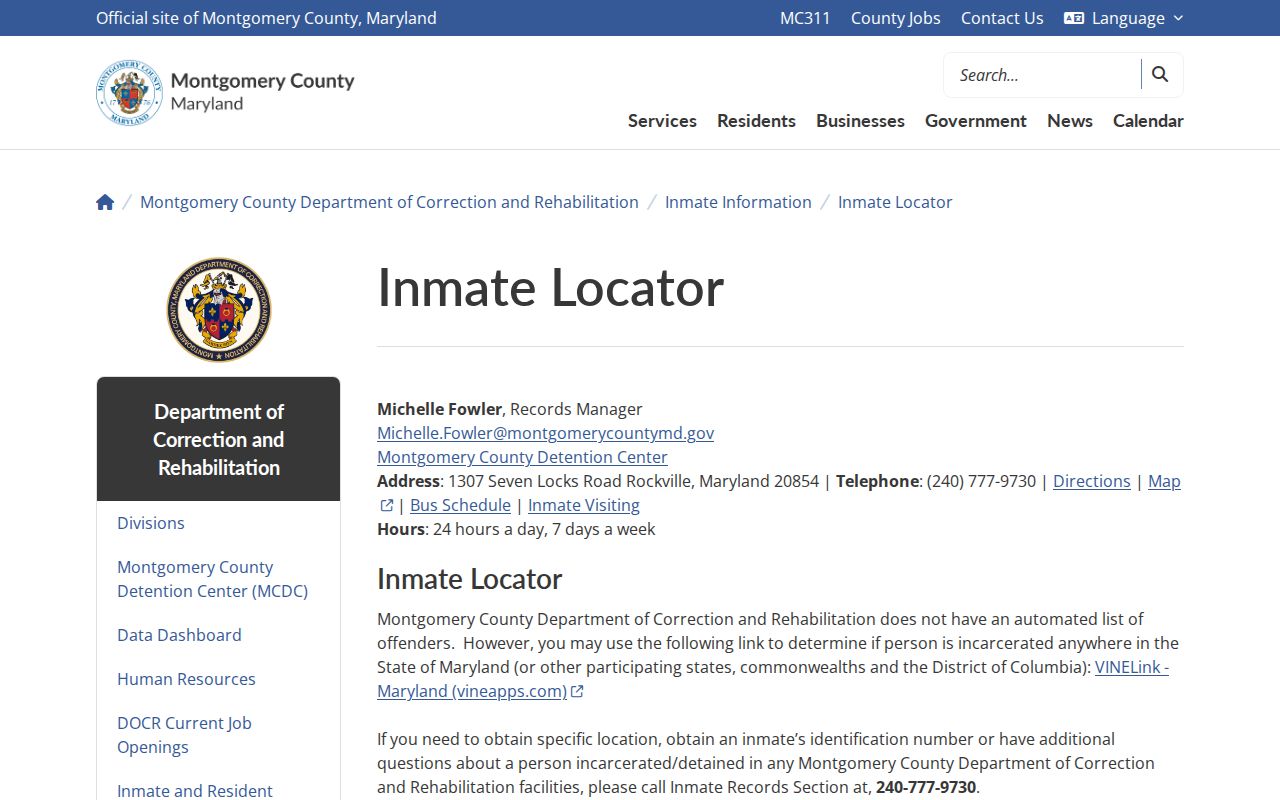
Fax requests may go to 240-777-9740, and physical inquiries go to Inmate Records at the Montgomery County Detention Center on Seven Locks Road. VINELink is a separate notification channel, while the Maryland inmate locator concerns the state sentenced population. Police reports use the Police Records Division and may be limited to protect active work, confidential sources, victims, witnesses, or investigative methods.
Potomac Public Records Custodians
Most in-person public records work for Potomac leads to Rockville, the Montgomery County seat. The cards name the office that can supply the source record or explain its access channel. Hours and fees should be checked before a visit because a portal summary may not reflect counter changes.
Land Records Department
50 Maryland Avenue, Rockville, MD 20850
240-777-9477
Weekdays, 8:30 a.m. to 4:30 p.m.
Register of Wills
50 Maryland Avenue, North Tower 3220, Rockville, MD 20850
240-777-9680 records
Weekdays, 8:30 a.m. to 4:30 p.m.
District Court Clerk
191 East Jefferson Street, Rockville, MD 20850
301-563-8800
Civil and traffic/criminal files
MC311 at 240-777-0311 routes county questions, including older personal-property tax inquiries and department contacts. For land systems, the Maryland State Archives Help Desk assists with MDLandRec and Plats.net at 410-260-6487. The Land Records office does not keep individual house-location plats, even though filed subdivision and condominium plats may appear in Plats.net.
Potomac Records Access Terms
A few precise terms prevent costly requests. An online name hit may only prove that an index points toward a record. A certified copy serves a different purpose from a screen print, and an exemption may protect just part of a file rather than the whole record.
- Index
- A finding aid listing names, dates, numbers, or filing facts. It is not always the full record.
- Image
- A scan of the filed document, such as a deed page linked from its index.
- Certified copy
- A copy carrying the custodian's formal attestation that it matches the office record.
- Custodian
- The agency or official responsible for the requested record.
- Exemption
- A legal basis to withhold protected information while releasing any separable open portion.
For example, a Case Search line is an index-style summary, while a pleading in the clerk file is part of the underlying case. A parcel card reports assessment facts, while a deed image records the conveyance. Ask which form is needed before paying for copies or certification.
Maryland Law Opens Potomac Records
The Maryland Public Information Act gives all persons, not just state residents, access to information about government affairs and official acts. It favors the least cost and least delay unless disclosure would cause an unwarranted invasion of privacy. The law reaches existing records held by a custodian. It does not require an agency to answer a broad question, research a person, or create a new analysis.
A custodian normally has up to 30 days to respond. When production cannot occur promptly and will take more than 10 working days, the written response must explain why, estimate completion, and address cost. Search and preparation may be charged at a reasonable rate, but the first two hours are generally free. If an electronic record already exists in searchable or analyzable form, GP §4-205 supports production in that form when protected data can be removed.
Note: A narrow request naming the series, date span, identifiers, desired columns, and file format can reduce both delay and fee exposure.
Submit a Potomac Records Request
Start with Montgomery County's department-level MPIA contacts rather than sending a general question to a Potomac address. Deeds go to Land Records, court files to the right clerk, estates to the Register of Wills, police reports to Police Records, and permits to DPS. Ask to inspect when that is enough, or state whether electronic or paper copies are wanted.
- Identify the record series and the office that created or keeps it. An MPIA request sent to the wrong office adds routing time.
- Search the official index first. Save names, case numbers, account numbers, liber/folio, incident numbers, and exact date ranges.
- Describe existing records, not a question for staff to investigate. State the preferred format, whether inspection works, and whether rolling production is acceptable.
- Ask for a fee estimate before chargeable work. Narrow the dates, fields, or record type if the estimate is too high.
- If access is denied, request the written statutory basis and all separable, nonexempt portions. Then consider Ombudsman mediation, Compliance Board review where available, or court.
The county's online MPIA instructions and request control shown below illustrate the county route.
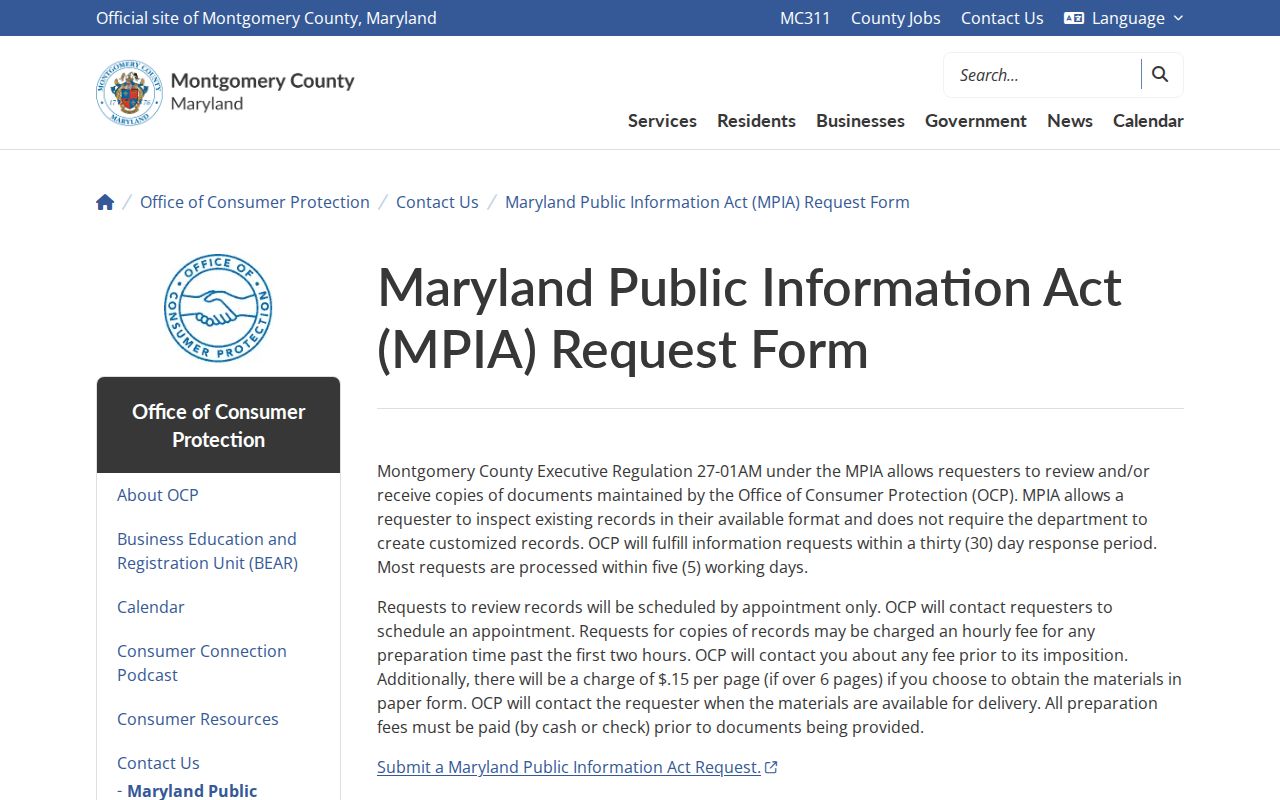
The county form asks for contact details, a detailed description, date range, and inspection or delivery preference. The Office of Consumer Protection model may charge $0.15 per paper page after six pages and preparation beyond two free hours, but it is office-specific, not a countywide fee promise.
Lawful personal use. Access to Potomac public records never permits stalking, threats, residential surveillance, harassment, or harm. Respect protected addresses and use each record only within its legal limits.
Challenge a Potomac Records Denial
A denial should identify the legal ground for withholding. Ask the custodian to release any portion that can be separated from protected content. If the dispute concerns delay, fees, or another access issue, Maryland offers more than one review path.
The Attorney General's PIA guidance describes mediation through the Public Access Ombudsman. After Ombudsman efforts, some complaints may fall within the Public Information Act Compliance Board's authority. Judicial review remains available under Title 4. These paths differ, so preserve the request, response, fee estimate, dates, and cited exemptions.
Privacy may still control the result. Motor-vehicle personal information, protected residence addresses, medical facts, recent vital certificates, and sealed judicial material do not become open simply because a request is detailed. When the source record itself is wrong, use the custodian's correction or review route rather than asking a commercial listing to hide the error.