
Verify Potomac Voter Registration
The free Maryland Voter Lookup is the first stop for a Potomac resident checking a known record. It needs facts tied to that voter’s registration, so it is an authenticated self-service tool rather than a public name directory. The service does not require an account and says its data are updated each day. Enter the name as registered, the birth date, and the five-digit Maryland residential ZIP. Street number and middle initial can help narrow the match.
The lookup form uses these exact fields and limits:
| Lookup field | Input | Needed | Format rule |
|---|---|---|---|
| First Name | Text, 30 characters | Yes | Use the registered form; letters and spaces only |
| Last Name | Text, 30 characters | Yes | Letters, hyphens, and spaces |
| Date Of Birth | Month, day, year | Yes | Numeric MM, DD, and YYYY fields |
| Zip Code | Text, 5 characters | Yes | Exactly five digits from the registration record |
| Street Number | Text, 10 characters | No | Registered residence number; common fractions may be entered |
| Middle Initial | Text, 1 character | No | One letter, as registered |
The only actions are Search and Clear. There is no party, county, precinct, wildcard, export, or surname-browse control. That narrow design protects the difference between confirming one’s own voter registration and obtaining a controlled voter file.
The official Potomac voter lookup source appears below. Its fields show why a person needs several matching facts before any result can appear.
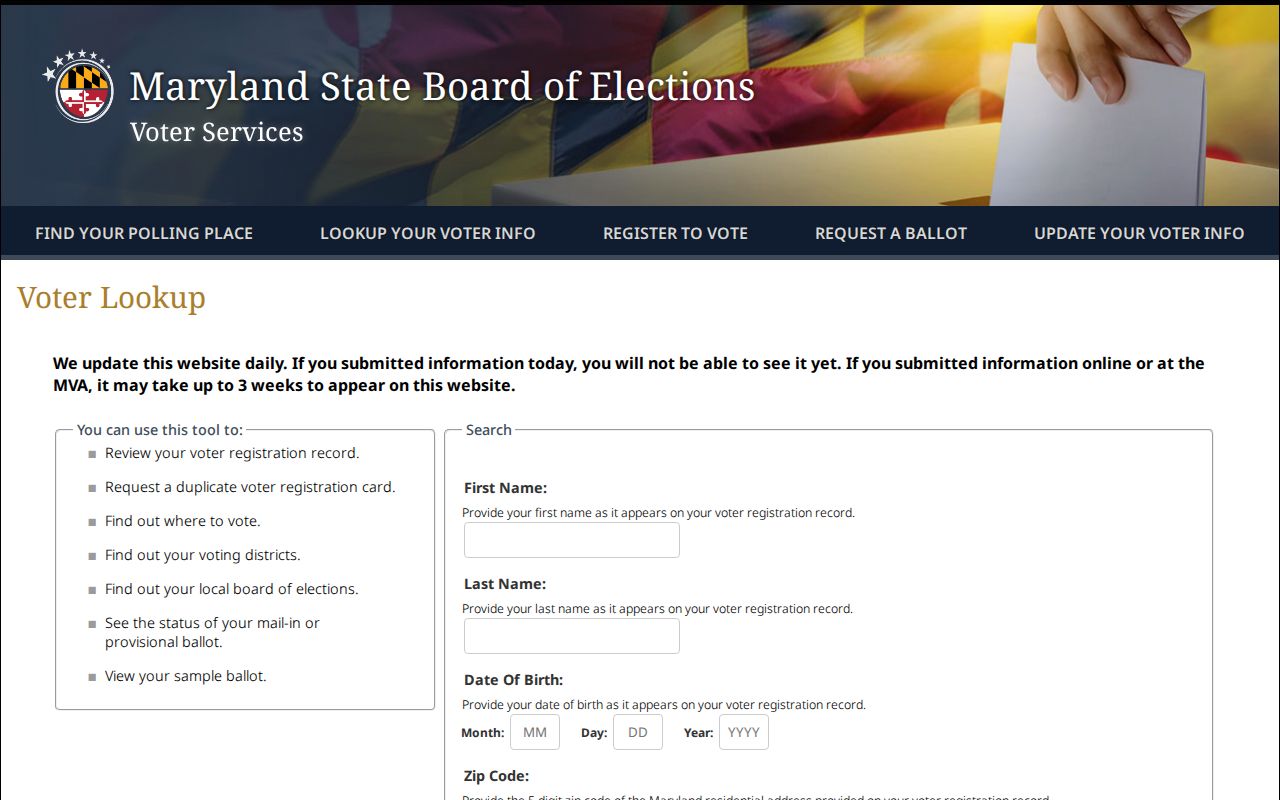
This screen is for verification, not open discovery of Potomac voter records.
Potomac Voter Lookup Results
A successful match can do more than state that a person is registered. The service may present the registration record, assigned polling place, voting districts, local election board, a sample ballot, and the status of a mail-in or provisional ballot. It also supports a request for a duplicate registration card. These outputs help a Potomac voter prepare to vote and check an action already taken.
The result inventory has several distinct parts:
- Registration record: the voter’s matched registration and current administrative information.
- Polling place: the assigned voting site for the record.
- Districts: the electoral areas connected to the registered residence.
- Ballot tools: a sample ballot plus mail-in or provisional status where applicable.
- Board contact: the local board responsible for questions or corrections.
Party affiliation can be part of Maryland registration because the application offers recognized-party affiliation and explains how that choice relates to party primaries. A displayed status is an election-administration fact. It is not broad proof about a person’s present location or day-to-day life.
Note: Voting history records participation and sometimes method, but no voter record reveals how anyone marked a ballot.
Fix a Potomac No-Match
A failed Potomac voter registration lookup does not prove that a person is unregistered. First retry the exact name used on the voter record. A recent name change may require the prior name, while a recent move may require the former ZIP. A registration submitted through the Motor Vehicle Administration can take up to three weeks to appear in the lookup. The state tool itself points users to these checks.
If the result still fails, contact the Montgomery County Board of Elections rather than trying to browse for a similar name. Staff can explain whether the voter should update a registration, wait for processing, or use another service. The local board is also the sound fallback when ballot status or district details seem wrong.
Identity check tip. Keep the registered spelling, former ZIP, submission date, and any transaction receipt at hand when asking the board to trace a missing record.
Maryland Voter Records Fields
The current state request form documents a much broader data file than the public self-lookup. Depending on the approved product, voter records can include identity, registration, party, address, precinct, district, and status fields. The controlled file can also carry birth date, gender, and voter ID. Those sensitive fields are supplied through an approved application, not through anonymous web browsing.
| Identity | Voter ID; first, middle, and last names; suffix; gender; birth date |
|---|---|
| Addresses | Residence and mailing addresses, except a protected Safe at Home residence address |
| Registration | Status, party, registration date, precinct, and county |
| Districts | Congressional, legislative, county council, school board, municipal, and other requested geography |
| History file | Election date, description, type, party, code, voting method, voting date, location, jurisdiction, and county |
| Never shown | A voter’s ballot choices |
Maryland’s form does not list Social Security numbers, driver’s-license or MVA identifiers, or registration signatures as release fields. Those items should not be assumed present. Even when a qualified requester receives birth dates or voter IDs, prudent handling matters because the data remain sensitive and their use is tightly limited.
Potomac Voter Record Privacy
Maryland Election Law section 3-506 sets the main access boundary. It allows a copy for a registered Maryland voter who submits a written application and sworn statement of electoral use. It also bars disclosure of a residence address protected through the Address Confidentiality Program. The public lookup’s identity gate and the list application’s oath are two different controls serving that same privacy framework.
Confidential by law. A Safe at Home participant’s residence address must not be released. Administrative identifiers not listed as release fields should never be inferred to be public.
The Maryland Safe at Home program gives eligible threatened people a legal substitute address and free mail forwarding. It began in 2006, uses trained Application Assistants, and cannot erase an address that was already public. A participant does not need a separate State Board of Elections application to suppress the protected residence address from released voter rolls.
Note: The state voter confidentiality form was updated in March 2025, while Safe at Home has its own enrollment route and statutory protection.
Potomac Voting History Limits
Election Law requires current voting history for at least the prior five years. A separate history file can pair voter ID with election date, election type, party, voting method, date credited, precinct, early-voting location, jurisdiction code, and county. History appended to a voter list may be easier to review in a spreadsheet, though a statewide appended request is limited to five chosen elections.
This history says only that participation was credited and may say how it occurred. It never records the selections made on a secret ballot. That distinction prevents a common and serious error: party affiliation, primary participation, or voting method cannot establish how the person voted. Use the history only for a valid electoral purpose and describe it as participation metadata.
Get Maryland Voter Records
The Application for Voter Registration Data, revised June 30, 2026, is the fully documented route for a voter file. The applicant must be a registered Maryland voter and provide personal contact details, a Maryland residential address, and proof or verification of registration. An organization may be identified too, but the named applicant signs the oath. One application is required for each list.
- Choose geography. Request Maryland statewide data or name a county, district, or municipality. Potomac records sit within Montgomery County.
- Select the product. Choose the registered-voter list, history appended, a separate history file, or another offered election list.
- Set voter filters. Pick active voters, a registration date range, named parties, or all registered voters of all parties including inactive records.
- Choose delivery. Secure FTP has no added fee. A flash drive can be picked up or mailed to an approved address.
- Sign and pay. Sign the electoral-use oath and submit full payment with the application.
A statewide list costs $125. A county, district, or municipality list costs $75. Flash-drive or mailed fulfillment adds $15, while FTP does not. The form accepts a credit card, certified check, personal or campaign check, or money order. Returned checks add $30. Processing is stated as within ten working days after receipt of the application and payment.
The State Board’s voter data page shows the current qualification, delivery, fee, and use framework.
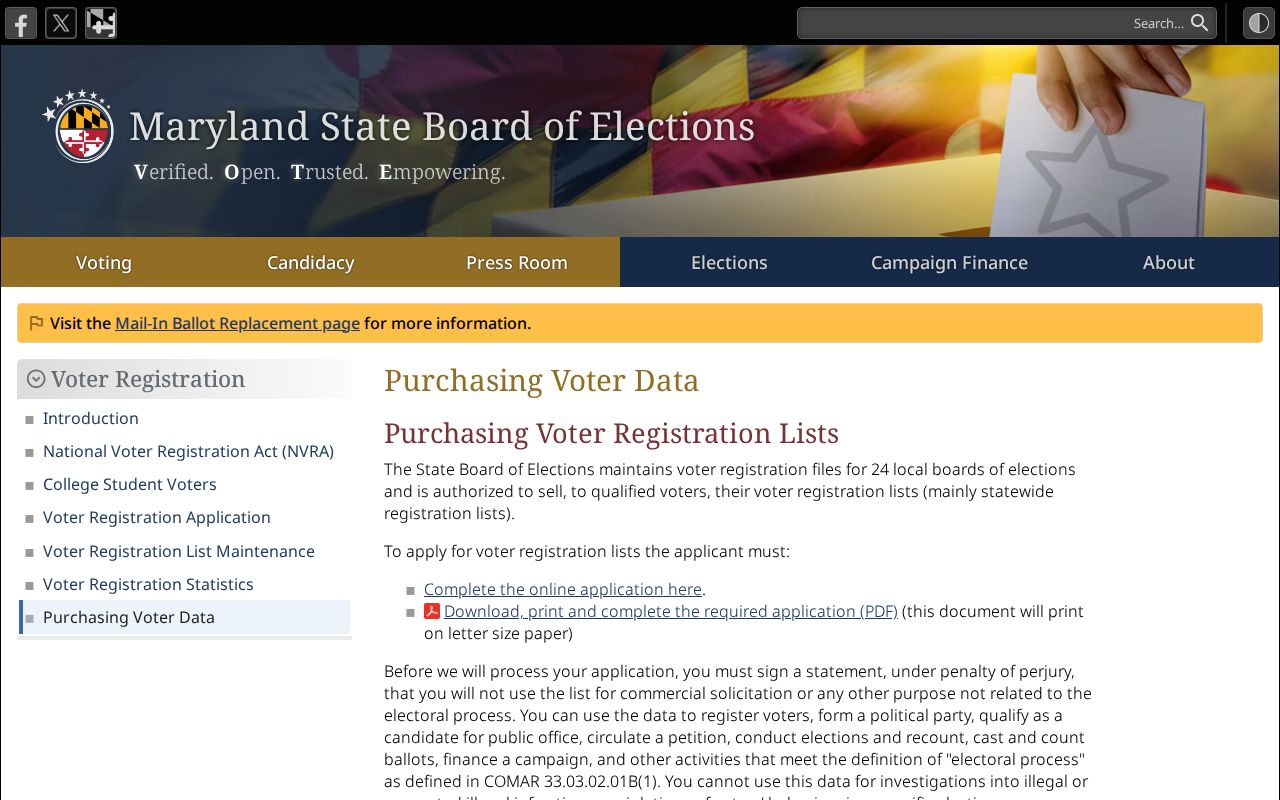
This official page should be checked with the current PDF because older media-fee snippets may be out of date.
Potomac Voter File Rules
The sworn statement permits uses related to the electoral process. Recognized purposes include registering voters, forming a party, qualifying candidates, conducting petitions, administering elections or recounts, casting and counting ballots, and campaign finance. The state says the file cannot be used to investigate suspected illegal voter conduct in a particular election. It also may not be sold, transferred, or redistributed to another party under the form oath.
Commercial solicitation and any purpose unrelated to the electoral process are barred. Knowingly allowing controlled voter data to be used for a non-electoral purpose is a misdemeanor under Election Law section 3-506 and Title 16 penalties. The rule follows the data after delivery. A requester should limit access, keep the source and request date, and dispose of stale copies with care. Never use voter records to stalk, harass, threaten, or harm anyone.
Note: General Maryland records-request principles are covered with other custodians on the Potomac public records page; voter files follow their own election-law process.
Montgomery Voter Records Office
The Montgomery County Board of Elections administers local services for Potomac. Its office is at 18753 North Frederick Avenue, Suite 210, Gaithersburg, Maryland 20879. Hours are Monday through Friday, 8:30 a.m. to 5:00 p.m. Call 240-777-8500, fax 240-777-8600, use Maryland Relay at 1-800-735-2258, or email elections@montgomerycountymd.gov.
The county products route includes an Application to View the Voter Registry and a countywide data application. A viewing request may be mailed, emailed to voter.registration@montgomerycountymd.gov, or faxed. Some county products are free, while others need advance ordering and prepayment. County data are reported as of the first of each month, with more frequent updates during election years. Because the linked local forms could not be fully inspected, confirm exact fields and prices with the board.
The local election service page for Potomac residents is shown below.
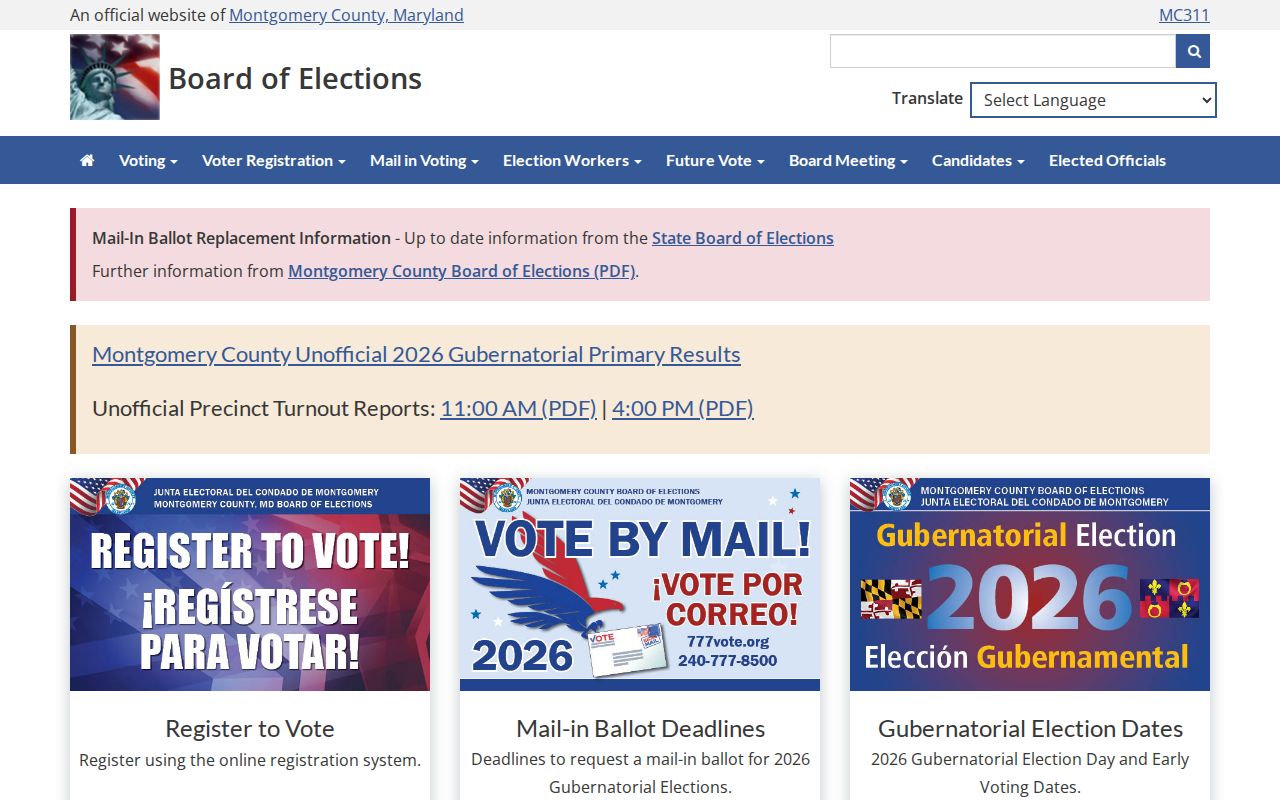
The county board is the direct fallback for corrections, registry viewing, local products, and a lookup that does not match.
Potomac Voter Roll Maintenance
The State Board’s list-maintenance process uses official data comparisons, local board work, and notice procedures. Address-confirmation steps can move a record to inactive status. Removal occurs only under governing state and federal procedures. An inactive label is an administrative state, not proof that a Potomac voter has left an address or the community.
A felony conviction does not create a permanent registration bar once the person has been released from a court-ordered sentence of incarceration. The state identifies buying or selling votes as the permanent-disqualification exception. These rules are another reason not to draw life conclusions from a status field alone. Confirm the current voter registration record with the voter or election board.
Historic Potomac Voter Records
Current lookup tools do not replace old voter registration books. The Maryland State Archives C3362 series, Montgomery County Board of Registry Voter Registration Record, covers 1896 through 1936 and 1944. Volumes are split by election district or precinct, year, and surname range. That structure makes the series a true historical name index, but the researcher must know or test older political geography.
Montgomery County poll books also survive for 1884 through 1895 in the Archives’ county-record survey. A surname in a voter register or poll book can tie a person to an election district and era. It does not prove that the old district had the same lines as modern Potomac. Potomac is an unincorporated census-designated place, not an election-record jurisdiction, so searches belong under Montgomery County and must account for boundary change.
The June 2026 state report provides modern scale, listing 707,821 active registrations across Montgomery County. It does not publish a Potomac CDP total. Keep that county number labeled as countywide, and do not turn it into a local estimate.